I have long believed that certain figures appear in history not only because of their personal actions, but because they embody questions that an entire era is beginning to ask. When such figures emerge, they often become symbols through which societies attempt to understand themselves.
This book was written from that conviction.
I am a Brazilian writer, journalist, poet, and philosopher. Throughout my life, I have been interested in observing how ideas move through societies and how certain voices come to represent deeper transformations taking place within culture and politics. My work has often been guided by a simple curiosity: how does a moment in history reveal the moral concerns of a civilization?
When Greta Thunberg first appeared in the global public sphere, I began following her trajectory with close attention. From her first solitary protest to her speeches before international audiences, I observed the extraordinary way in which her voice began resonating across continents. I read extensively about her activism, the movement that formed around it, and the debates that it provoked in political, cultural, and intellectual circles.
It soon became clear to me that Greta represented something larger than the story of a single activist.
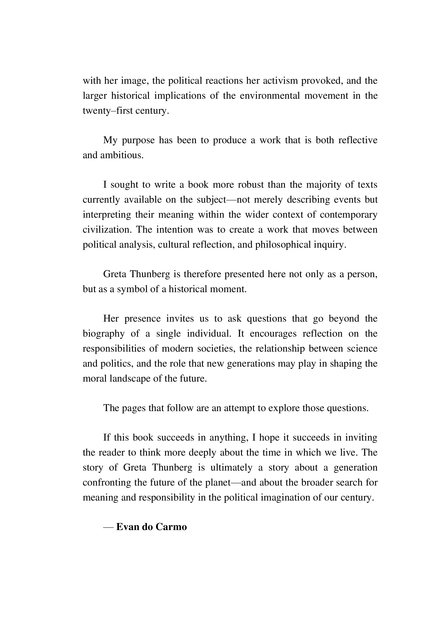
Many books and articles have already been written about her. Some approach her biography, others focus on the environmental movement, and still others examine the political controversies surrounding climate activism. Yet I felt that an i
| ISBN | 9798251824827 |
| Número de páginas | 289 |
| Edición | 1 (2026) |
| Formato | A5 (148x210) |
| Acabado | Tapa blanda (con solapas) |
| Coloración | Blanco y negro |
| Tipo de papel | Offset 80g |
| Idioma | Inglés |
¿Tienes alguna queja sobre ese libro? Envía un correo electrónico a [email protected]




Haz el inicio de sesión deja tu comentario sobre el libro.