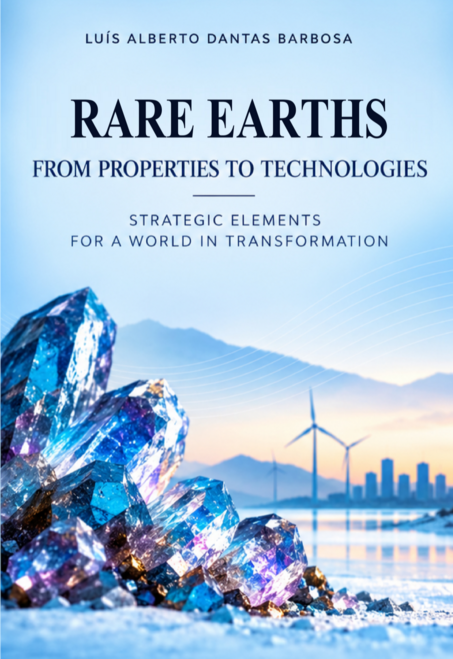
How are the properties of rare-earth elements transformed into technological functions?
Rather than simply presenting a list of applications, the book traces the pathway connecting the electronic structure of elements to material properties and, ultimately, to technological components and systems. Neodymium, praseodymium, cerium, europium, terbium, dysprosium, erbium, gadolinium, lutetium, and the other rare-earth elements are examined not merely in terms of where they are used, but, more importantly, the roles they perform.
The book begins by exploring the characteristics that make rare earths technologically distinctive and examines each of the seventeen elements individually. It then shifts perspective: instead of asking “What is each rare earth used for?”, it investigates which properties and functions are required for a technology to operate.
Along this journey, the book explores permanent magnets, motors, and generators; luminescent materials, lasers, and photonic systems; catalysis and the transformation of matter; energy storage, conversion, and transport; sensors and detectors; superconductors; magnetocaloric materials; scintillators; and quantum technologies, among other applications.
One principle runs throughout the discussion: a scientific property is not, in itself, a technology. Between the behavior of an element and the operation of a device lie composition, crystal structure, microstructure, processing, manufacturing, integration, and engineering decisions. C
| ISBN | 9786502428030 |
| Seitenanzahl | 281 |
| Ausgabe | 1 (2026) |
| Format | 16x23 (160x230) |
| Einband | Taschenbuch ohne Klappen |
| Farbe | Schwarz-Weiß |
| Papiertyp | Offset 90g |
| Sprache | Englisch |
Haben Sie Beschwerden über dieses Buch? Sende eine Email an [email protected]


Klicken Sie auf Anmeldung und hinterlassen Sie Ihren Kommentar zum Buch.