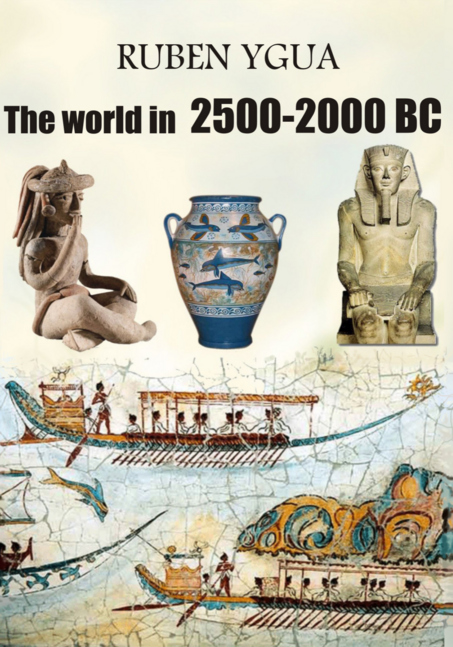
The world in 2500-2000 BC

By Ruben Ygua

Book code: 950781

Categories

History, Historical, History & theory, Fossils, Europe, Young adult non-fiction, Non-fiction, Geography and History, Didactic, Human and Social Sciences

Share this book
This page has been visited 62 times since 04/03/2026
Printed Version
€ 16,51
Total amount:
€ 16,51
* VAT not included.
E-Book Version
€ 7,09
Valor total:
€ 16,51
* VAT not included.
This e-book might also be available for sale at:

Synopsis

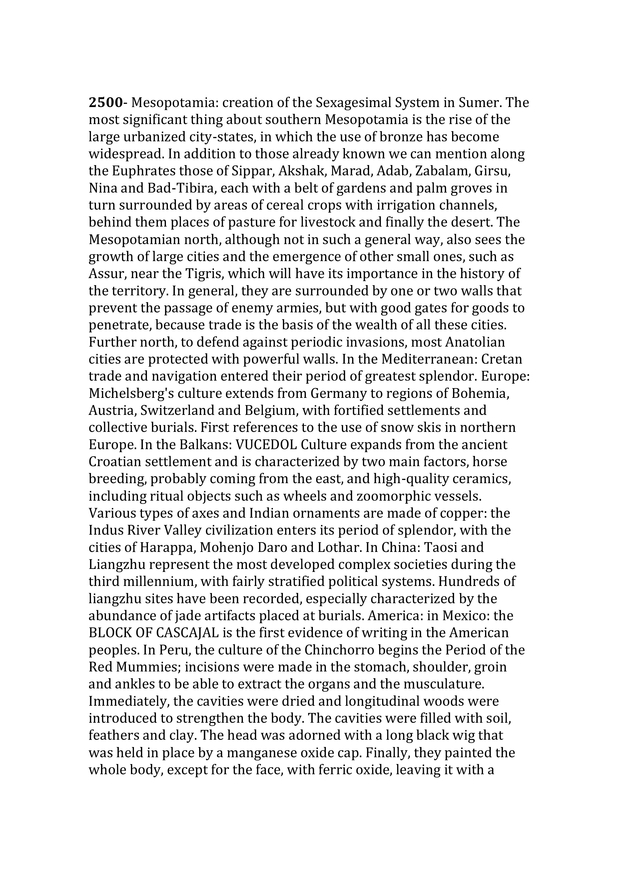
2500- Mesopotamia: creation of the Sexagesimal System in Sumer. The most significant thing about southern Mesopotamia is the rise of the large urbanized city-states, in which the use of bronze has become widespread. In addition to those already known we can mention along the Euphrates those of Sippar, Akshak, Marad, Adab, Zabalam, Girsu, Nina and Bad-Tibira, each with a belt of gardens and palm groves in turn surrounded by areas of cereal crops with irrigation channels, behind them places of pasture for livestock and finally the desert. The Mesopotamian north, although not in such a general way, also sees the growth of large cities and the emergence of other small ones, such as Assur, near the Tigris, which will have its importance in the history of the territory. In general, they are surrounded by one or two walls that prevent the passage of enemy armies, but with good gates for goods to penetrate, because trade is the basis of the wealth of all these cities. Further north, to defend against periodic invasions, most Anatolian cities are protected with powerful walls. In the Mediterranean: Cretan trade and navigation entered their period of greatest splendor. Europe: Michelsberg's culture extends from Germany to Bohemia, Austria, Switzerland and Belgium, with fortified settlements and collective burials. First references to the use of snow skis in northern Europe.VUCEDOL Culture expands from the ancient Croatian settlement...

Features

Number of Pages 68
Edition 1 (2026)
Format A4 (210x297)
Binding Paperback without Flaps
Color Black and White
Paper Type Uncoated offset 75g
Language English

Do you have complaints about this book? Send an email to [email protected]

Ruben Ygua

Historiador, romancista e ilustrador.

Uruguaio radicado no Brasil desde 1982. Desde meus tempos de estudante percebi que a História está sendo muito manipulada por interesses religiosos, nacionalistas e econômicos, deturpando o que aconteceu no passado. Cheguei à conclusião de que a melhor forma de estudar a História sería através de uma cronologia. Não se trata de uma cronologia simplificada das que existem muitas no mercado. Durante muitos anos coletei informação, dados e datas, preparando una completa cronologia abarcando a história total da Humanidade, incluindo a fundação de cidades, reinos e impérios, conquistas e descobertas, invenções e avanços científicos, tecnológicos e artísticos, mudanças climáticas, desastres, guerras, epidemias, a evolução da vestimenta civil e militar, a história da música, do sapato, das armas de fogo, da navegação, biografías, etc. De forma paralela, a cronologia é complementada por fatos que não se encaixam em uma data determinada, mas que pertenecem a toda uma época: curiosidades da vida social, costumes, a religião, etc.

A causa de seu enorme volumem se fez necessário dividir essa obra en uma série de livros, atlas e catálogos informativos.

Para finalizar, a partir de 2019 comecei a escrever alguns romances históricos, destacando a série Aventuras no Paleolítico, que até a data (2024) soma 18 episódios.

Mais publicações desse autor
Show Full List
Printed
€ 13,25
E-Book
€ 5,89
Printed
€ 12,77
E-Book
€ 5,89
Printed
€ 13,45
E-Book
€ 5,89
Printed
€ 13,17
E-Book
€ 5,89
Printed
€ 14,84
E-Book
€ 5,89
Printed
€ 13,17
E-Book
€ 5,89
Printed
€ 24,41
E-Book
€ 6,75
Printed
€ 14,38
E-Book
€ 5,89
Printed
€ 12,37
E-Book
€ 5,89
Printed
€ 16,34
E-Book
€ 7,61
Related Publications
Show Full List
Printed
€ 10,07
E-Book
€ 3,38
Printed
€ 14,83
E-Book
€ 5,37
Printed
€ 10,99
E-Book
€ 4,17
Printed
€ 9,55
E-Book
€ 3,38
Comments

Click Login to leave your comment on the book.

0 Comments